try to do an Tetrahedron
but i can only rotate around the Y Axis
and why are the green lines behind of the blue ones?
🧟 🙁
Platonic Solids
55 posts
the same prob. with an Octahedron:
You're using replace mode, so the next superscope will overwrite the previous one. You can use additive/maximum to get around this, but to do actual depth-culling is very difficult unless you shade by depth (z) and use maximum mode.
sometimes i hate avs like this 🙁 😢 😔
😛 <( LOL )
😛 <( LOL )
Well, that last one looks pretty good. 👍
Circle segments
I think the 3 partitions would look better as circle segments rather than triangles though...
I think the 3 partitions would look better as circle segments rather than triangles though...
i just try it!
here is the work in progess overwiew pac,
btw. same prob. 🙁 (can !only! rotate with x or y Axis)
GEEEKS Help määän! (before i try a supermäään logo!)
here is the work in progess overwiew pac,
btw. same prob. 🙁 (can !only! rotate with x or y Axis)
GEEEKS Help määän! (before i try a supermäään logo!)
I like all the Radioaktiv presets except for the first and last one...
I can see the limited rotation...
Your best bet to make it at least more dynamic - Use getosc/getspec on the OnBeat section.
I'll look into the coding some more and see if I can solve the prob...
I can see the limited rotation...
Your best bet to make it at least more dynamic - Use getosc/getspec on the OnBeat section.
I'll look into the coding some more and see if I can solve the prob...
hmm need a onbeat-function to move the 3 triangels around the Y-Axis (10°-20° back and forward (vY^)+(^Yv)).
then I don't need to redesign the 3 triangels! 😛
can somone explain getosc/getspec variable settings a bit more plz?!
then I don't need to redesign the 3 triangels! 😛
can somone explain getosc/getspec variable settings a bit more plz?!
You seem to have some trouble getting the 3 side-shapes right. Try this in one superscope:
if (i < 0.5) draw circle-arc (30°) clockwise at radius 90%
if (i > 0.5) draw circle-arc (30°) counter-clockwise at radius 20%
That should get you what you need. On top of that, you can easily rotate this shape by adding a phase-angle to the circle-arcs' begin and endpoints
Here's the scoop on getosc (same applies to getspec):
v = getosc(point,width,channel);
point is a value from 0...1 that defines which oscilloscope point you want
width is a smoothing parameter. a value of 0 means no smoothing (normal behaviour), a value of 0.1 means that the surrounding values that are in the range of 10% will be blended. For example getosc(0.3,0.1,0) will grab all the values between 0.25 and 0.35 and average them. This is useful if you want a shape to be sound responsive, but not get too distorted by high frequencies (rapid changes).
channel sets which sound-channel you need, 0=center, 1=left, 2=right
if (i < 0.5) draw circle-arc (30°) clockwise at radius 90%
if (i > 0.5) draw circle-arc (30°) counter-clockwise at radius 20%
That should get you what you need. On top of that, you can easily rotate this shape by adding a phase-angle to the circle-arcs' begin and endpoints
Here's the scoop on getosc (same applies to getspec):
v = getosc(point,width,channel);
point is a value from 0...1 that defines which oscilloscope point you want
width is a smoothing parameter. a value of 0 means no smoothing (normal behaviour), a value of 0.1 means that the surrounding values that are in the range of 10% will be blended. For example getosc(0.3,0.1,0) will grab all the values between 0.25 and 0.35 and average them. This is useful if you want a shape to be sound responsive, but not get too distorted by high frequencies (rapid changes).
channel sets which sound-channel you need, 0=center, 1=left, 2=right
TILT!
sorry, need a break! 😳
perhaps I will try to fix this later?!
sorry, need a break! 😳
perhaps I will try to fix this later?!
its like pot-strike: it becomes warmer 🧟 🤪
- fixed the Octahedron 🙂
- make a Cuboctahedron, a Torus + a cell:
- make a Cuboctahedron, a Torus + a cell:
All this math is *WHOOSH* above my head 📻
I just started learnind Dynamic Movements 🙂
I just started learnind Dynamic Movements 🙂
yea, do this and tell me how to use them 😉
Well...As for the rotation, you could just apply the scope(s) to a normal 3D rotation (I explained this in my Primer, but no one seems to be downloading it 🙁 it's probably at the bottom of the forum by now 😢 )
BTW, sorry, but I haven't actually looked at the preset, I don't have WA on this comp (nor do I have access to a comp with WA). I'm just catching up with the forums while I'm away...
BTW, sorry, but I haven't actually looked at the preset, I don't have WA on this comp (nor do I have access to a comp with WA). I'm just catching up with the forums while I'm away...

Your radioactive three-foil sign looks perfect 🙂
Originally posted by 3dinoNuke.ACE?
my last work: (sorry, it is not perfect!)
<<!nuke.ace>>
WTF? How the hell did I miss this one?
Anyway, I better check out these presets.
Xion, .ace is a zip alternative.
Anyway, I better check out these presets.
Xion, .ace is a zip alternative.
>Xion got to => http://www.winace.com/ 😉 (i think, winzip also support ace-files)
>jheriko, do you make your icosahedron pic with an ssc?
>UnConeD: "Your radioactive three-foil sign looks perfect 🙂"
Thanks, Yes but i like to cange:
1. the rotation, (x/y/z & reaction on beat)
2. add yellow or green Fog,
3. filled shapes (dark-green or black).
please, give me some tips! 🙂
>
who will try to do this?
>If you have VRML installed, check this: Tetraeder Spirale
>jheriko, do you make your icosahedron pic with an ssc?
>UnConeD: "Your radioactive three-foil sign looks perfect 🙂"
Thanks, Yes but i like to cange:
1. the rotation, (x/y/z & reaction on beat)
2. add yellow or green Fog,
3. filled shapes (dark-green or black).
please, give me some tips! 🙂
>
who will try to do this?
>If you have VRML installed, check this: Tetraeder Spirale
Yup, its a ssc.
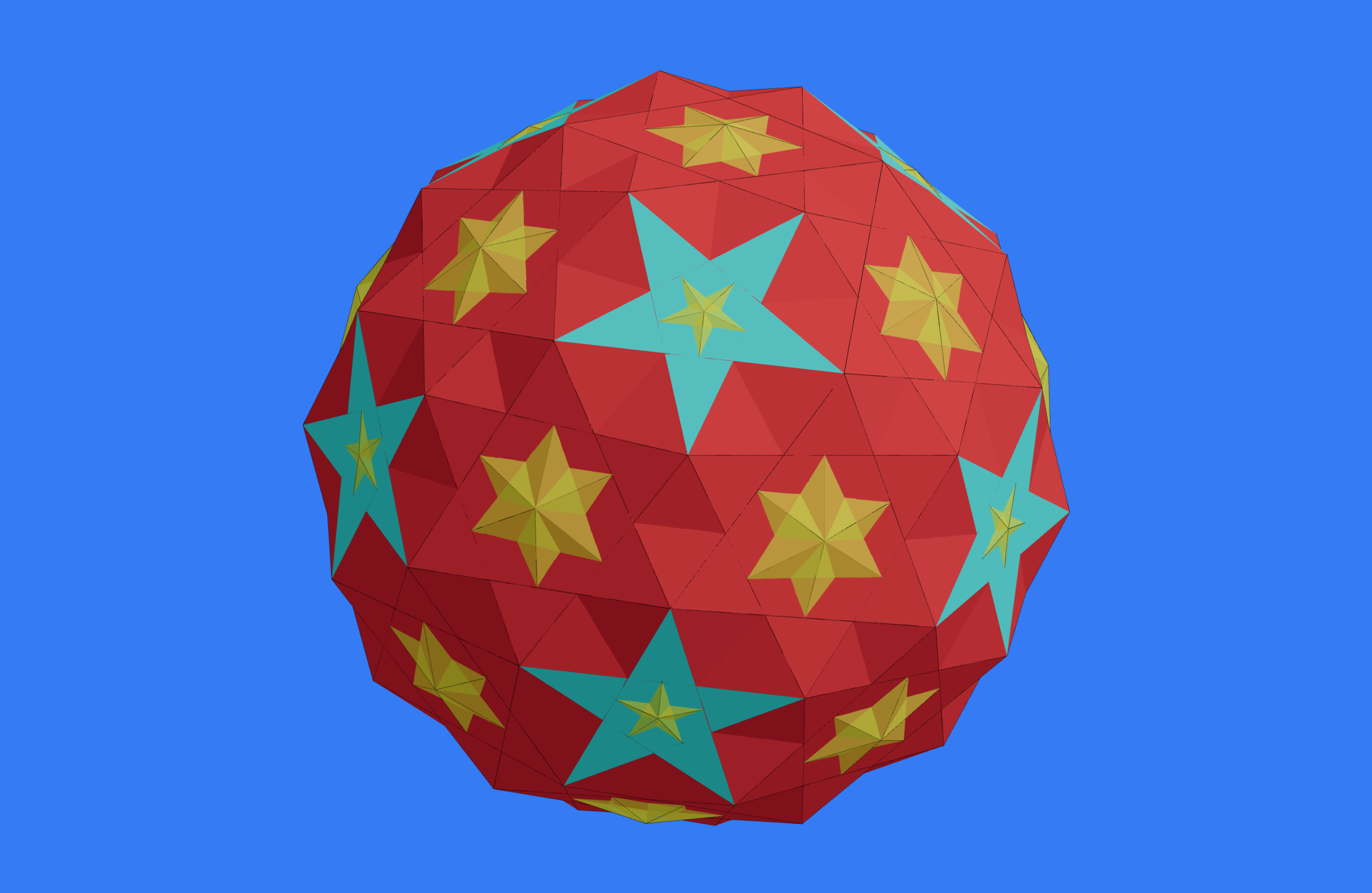
The reason I was a bit surprised at seeing this thread is because I released a minipack containing presets centred around the Platonic solids which contains a preset for each of them, 4 of them use filled faces made from scopes and one of them uses wireframe. If you are interested I have also made a rhombic dodecahedron which features in my Pack VI. My next pack will probably feature a couple of other solids, I did make a cuboctahedron but that ones already been done so I'm working on a icosidodecahedron (triacontrahedron with pentagonal and hexagonal faces - like a soccer ball) by using the golden ratio do determine its vertices and a rhombic triacontrahedron by using powers of the golden ratio.
Here are links to my the packs I mentioned above:
Purely Platonic
Jheriko - Pack VI
If you really want that animated gif as an AVS preset, I could do probably do it in wireframe, doing it solid would require that the vertices were ordered in a specific way (clockwise or anti-clockwise) but it is possible, I may give it a pop if I'm feeling mathematical later on...
Yeah your radioactive symbol was very good, if you want to fill it in I can give you some recommendations. To fill the circle the easiest way is probably to make your ssc go from the centre to one of the circle points, then back again, then to the next point on the circle... by using an alternating variable per point. I'd recommend that if you are going to do it, NOT to do it that way since although it is easy to code it will look like poo without a very high number of points, it would be better to make lines that zigzag across the circle by spliting it into two equal curves (vertical semi-circle then mirror it with x=-x would proably be easiest) and use an alternating variable to make it draw lines from the first point on one curve to the second point on the other back to the third on the first... and so on. You could fill the other shapes by mathematically defining them in a similar way since they are all symetrical, and since they are made of lines and circle arcs it shouldn't be too difficult to figure out.
🙂
The reason I was a bit surprised at seeing this thread is because I released a minipack containing presets centred around the Platonic solids which contains a preset for each of them, 4 of them use filled faces made from scopes and one of them uses wireframe. If you are interested I have also made a rhombic dodecahedron which features in my Pack VI. My next pack will probably feature a couple of other solids, I did make a cuboctahedron but that ones already been done so I'm working on a icosidodecahedron (triacontrahedron with pentagonal and hexagonal faces - like a soccer ball) by using the golden ratio do determine its vertices and a rhombic triacontrahedron by using powers of the golden ratio.
Here are links to my the packs I mentioned above:
Purely Platonic
Jheriko - Pack VI
If you really want that animated gif as an AVS preset, I could do probably do it in wireframe, doing it solid would require that the vertices were ordered in a specific way (clockwise or anti-clockwise) but it is possible, I may give it a pop if I'm feeling mathematical later on...
Yeah your radioactive symbol was very good, if you want to fill it in I can give you some recommendations. To fill the circle the easiest way is probably to make your ssc go from the centre to one of the circle points, then back again, then to the next point on the circle... by using an alternating variable per point. I'd recommend that if you are going to do it, NOT to do it that way since although it is easy to code it will look like poo without a very high number of points, it would be better to make lines that zigzag across the circle by spliting it into two equal curves (vertical semi-circle then mirror it with x=-x would proably be easiest) and use an alternating variable to make it draw lines from the first point on one curve to the second point on the other back to the third on the first... and so on. You could fill the other shapes by mathematically defining them in a similar way since they are all symetrical, and since they are made of lines and circle arcs it shouldn't be too difficult to figure out.
🙂
jheriko 👍
very nice pacs!
hope, i will get more time for avs (shool work sucks! 😠 )
some nice links:

very nice pacs!
hope, i will get more time for avs (shool work sucks! 😠 )
some nice links:

Encyclopedia of Polyhedra, with virtual reality models
Centre for Astrophysics and Supercomputing
I don't suppose you happen to have any links which list polyhedral vertex co-ordinates, I'm gettig really sick of working them out, some of the larger ones take ages, especially when they have very little symmetry since you have to work out practically every vertex individually. 🙁
Maybe you could model them in CAD/3DSMAX and export the coordinates as a textfile?
Sounds like a good idea, but would those co-ords be nice numbers? Probably some hashed up messy skank using square roots every which way...
Then again I could just divide them all by varying powers of phi to make them nicer. Thats mainly so tht the code is easier to type in and nicer to look at otherwise I'd end up with something like:
x1=if(equal(q,3),1.078912323,x1);
y1=if(equal(q,3),2.414276302,y1);
...
which is hassle if you have to type out numbers like that 90 times. 😛
Then again I could just divide them all by varying powers of phi to make them nicer. Thats mainly so tht the code is easier to type in and nicer to look at otherwise I'd end up with something like:
x1=if(equal(q,3),1.078912323,x1);
y1=if(equal(q,3),2.414276302,y1);
...
which is hassle if you have to type out numbers like that 90 times. 😛
3 decimals should be enough...
I guess as a mathematician I have some kind of bizarre desire to see numbers being expressed as accurately as possible... I did a few web searches to find co-ordinates and I managed to find a few sites with co-ordinates for the platonic solids and some other shapes defined in terms of numbers like sqrt(2) and phi so I'm going to be lazy and use some of them. Thanks for the tip though.
If any one else is interested:
This one saved me the trouble of figuring out the rest of the rhombic triacontahedron. It also has a few more co-ords.
If any one else is interested:
This one saved me the trouble of figuring out the rest of the rhombic triacontahedron. It also has a few more co-ords.
As an engineering student I see math as the tool I need to solve certain problems. If you don't need anymore accuracy, why bother? 🙂
At 320 width, one pixel is 0.00625 AVS units wide. So for a 2D scope you don't need any more than 3 decimals in your constants. Given the fact that in 3D scopes, you divide by Z (> 1) most of the time, usually you can settle for 2 decimals.
At 320 width, one pixel is 0.00625 AVS units wide. So for a 2D scope you don't need any more than 3 decimals in your constants. Given the fact that in 3D scopes, you divide by Z (> 1) most of the time, usually you can settle for 2 decimals.
Originally posted by jherikolike pi? try:
I guess as a mathematician I have some kind of bizarre desire to see numbers being expressed as accurately as possible...